It is 6:45pm on a Friday. Your dining room is full, the kitchen is six tickets deep, and the phone has been ringing for twenty minutes straight. The host is seating a party of six, the bartender is covering the host stand, and every time the phone rings, somebody glances at it and silently hopes it stops. It does not stop. Some of those callers want a table. Some want takeout. Some are standing outside your door right now asking if you are still seating. Every one of them is a customer trying to give you money, and your phone is the only thing standing between them and your kitchen.
That is the restaurant phone problem in one scene, and it is not a staffing problem you can solve by hiring your way out of it. The phone rings hardest exactly when your people are busiest, which is the dinner rush, and it keeps ringing after your people go home, which is every night after closing. A phone that only works when someone is free to answer it is a phone that fails at the two moments that matter most.
I run a company that builds AI receptionists for small businesses, and restaurants were one of the first places we tested the idea, because the phone math there is so unforgiving. This post is the honest version of what AI phone answering can and cannot do for a restaurant: how it handles takeout orders, reservations, and after-hours calls, what to look for if you shop for one, and where the limits are. Take my word the way you would take a supplier's advice about buying a supplier's product: useful, but notice my incentives.
The calls a restaurant actually gets
Before the checklist, it helps to name what the phone is doing for a restaurant, because it is not one job. It is five or six jobs sharing a single line, and they are worth very different amounts of money.
The takeout order. This is the money call. Someone wants dinner, they know roughly what they want, and they are calling two places at once while they decide. If you answer first and take the order cleanly, you get the sale. If the phone rings out, they order from the place that picked up, and you never even knew they called. A Friday night can easily mean twenty or thirty of these, and every one that goes to voicemail is a bag of food walking out of somebody else's door.
The reservation. A party of four for Saturday at 7, a birthday for twelve next Friday, a couple asking if you have anything tonight. These callers need a yes or a no and a time, and they need it now, because they are planning their evening around your answer. A reservation call that goes unanswered is not a deferred booking. It is a table at the restaurant down the street.
The "are you open" call. What time do you close tonight, do you have outdoor seating, is the patio dog friendly, do you have a kids menu, where do I park. These are thirty-second questions, and they are the calls your staff hates most, because they interrupt real work to answer something that never changes. They are also the calls an AI handles best, because the answers never change and the AI never gets tired of repeating them.
The catering and large-party inquiry. A company lunch for forty, a rehearsal dinner, a holiday party. These callers are worth hundreds or thousands of dollars, and they are judging you by the first thirty seconds. A phone that answers instantly, asks the right questions about date, headcount, and budget, and takes a detailed message for the owner sounds like a restaurant that can handle their event. A phone that rings out sounds like one that cannot.
The complaint and the fix. A wrong order, a late delivery, a disappointing meal. These callers are upset, and the way the phone handles them decides whether they come back. Somebody has to listen, apologize without arguing, and get the details to a manager fast. This is the call type where the AI's job is mostly to be calm, take the details down properly, and escalate, not to solve the problem itself.
The driver and the vendor. The delivery driver who cannot find the back door, the produce supplier confirming tomorrow's delivery, the linen company asking about the gate code. Boring calls, absolutely load-bearing, and every one of them interrupts a cook or a server who is in the middle of something else.
Notice the pattern. Almost none of these calls need a chef or a manager on the phone. Almost all of them need someone friendly, fast, and available at the exact moment the caller is deciding where to spend money. That is the job. If you want the short version of how this works for restaurants specifically, I put together a page on restaurant order taking that walks through the whole setup.
What a good takeout call sounds like
Abstract features are hard to judge, so here is what a Friday night takeout call should sound like. Caller: "Hi, can I place a takeout order?"
A good AI receptionist: "Of course, happy to help. What can I get for you tonight?" Caller orders a margherita pizza, a Caesar salad, and two orders of garlic knots. "Great. That is one margherita pizza, one Caesar salad, and two garlic knots. Anything to drink with that?" Caller adds a bottle of sparkling water. "Your total is $48.50. Would you like to pick up in about twenty minutes, or should we have it ready at 7:30?" Caller picks 7:30. "Perfect. Can I take a name for the order?" Then it takes the name and phone number, reads the order back once to confirm, and texts a confirmation with the pickup time and the total.
The whole thing takes two minutes. The caller hangs up with dinner sorted, and your staff never touched the phone. Notice what the AI did: it took the order item by item, confirmed it back, stated the total plainly, offered a pickup time instead of making the caller guess, and sent a text so nobody has to remember anything. That is the job, and it is a job your host cannot do while seating a party of six.
Now the hard part, honestly. A takeout order is only as good as the menu the AI knows. If your menu changes, if the special tonight is not in the system, if a dish is 86'd at 7pm and the AI keeps selling it, the whole thing falls apart. The system has to know your real menu, your real prices, your real pickup times, and it has to be easy for you to update those things yourself when they change. If the vendor cannot show you how a menu change works, walk away, because a takeout AI with a stale menu is worse than no AI at all. Ask them to change a price and remove an item during the demo and watch how long it takes.
After hours: the calls you never hear
Your restaurant closes at 10pm. The phone keeps ringing until midnight, and it starts again at 8am, two hours before anyone is in the building. Those are not nuisance calls. They are people planning lunch, ordering for tonight, asking if you cater, and trying to book a table for the weekend. Every one of them that hits voicemail is a customer who will try the next restaurant on their list, and most of them will not call back.
After-hours coverage is where an AI receptionist earns its keep for a restaurant, because the alternative is nothing. There is no host at 11pm. There is no manager at 8am. The AI answers in your restaurant's name, takes the takeout order for later pickup or for when you open, books the reservation for Friday, answers the hours and parking questions, and texts a confirmation. The caller gets helped at the moment they decided to call, instead of getting a recording that tells them to call back during business hours, which is the same as telling them to call someone else.
The thing to test here is the same as with any after-hours system: call the demo line at 11pm on a Saturday and see what happens. The AI should answer in your restaurant's name, handle a takeout order for tomorrow, book a reservation, and text a confirmation. If the vendor will only demo during business hours, that tells you everything. The value lives after closing, so the test has to happen after closing.
The Friday night problem, and what actually fixes it
The dinner rush is the hardest phone problem a restaurant has, because it is a capacity problem, not a politeness problem. You have one host, one phone, and forty calls in two hours. No human being can answer all of them and seat tables at the same time. Something has to give, and what gives is usually the phone.
An AI receptionist fixes this by being unlimited in exactly the way a person is not. It answers the second call while the first is still talking. It answers the tenth call while your host is walking a party to their table. It never puts anyone on hold for five minutes while the host finishes something else, and it never forgets to call back, because there is no call back. The caller gets helped in the moment, and your host gets to do the job only a human can do, which is looking a guest in the eye and making them feel welcome.
This is also the reason the usual fixes do not work. A second phone line does not help, because you still have one host. An answering service does not help, because it takes a message and you call back later, and later is after the caller already ordered from somewhere else. A bigger host stand does not help, because the bottleneck is a person, not a desk. The fix is a phone that does not need a person, for the calls that do not need a person, so the person is free for the guests standing right in front of them.
What to look for: the restaurant checklist
Here is the list I would hand to a restaurant owner friend. In order of how much each item matters.
1. It takes a real takeout order, item by item, with your real menu and prices. This is the big one, and it is where most generic AI receptionists fail a restaurant. The AI needs your menu, your modifiers, your sizes, your prices, and your pickup times. It needs to read the order back, state the total, and confirm the pickup time. Ask the vendor to run a full takeout order on the demo line, with a substitution and a question about an allergen, not just a polite reservation at noon.
2. It books reservations into your real book, with your real rules. A table for two at 7 is not the same as a party of twelve on a Saturday. The AI needs to know your table sizes, your seating times, your large-party policy, and whether a booking needs a deposit or a manager's approval. Ask the vendor to show you a booking that respects a real constraint, like no parties over eight without a call back, not just "a table for tonight."
3. After-hours coverage you have actually tested, at 11pm. A huge share of the value is nights and mornings, so do not accept a demo that only shows lunch-hour calls. Call the demo line late on a Saturday and see what happens. The AI should answer in your restaurant's name, take a takeout order for the next day, book a reservation, and text a confirmation. If the vendor will not let you test after hours, that tells you everything.
4. It answers the questions your staff answers fifty times a day. Hours, parking, outdoor seating, kids menu, gluten free options, delivery radius, whether you take walk-ins. This is pure FAQ work and it is perfect for an AI, because the answers never change and the AI never gets tired of repeating them. The check: can you update the answers yourself when your hours change for the holidays, without filing a support ticket?
5. It handles the unhappy caller without making things worse. The AI should listen, apologize without arguing, take the details down properly, and get them to a manager fast, usually by text. It should never argue about a bill, never promise a refund it cannot give, and never try to talk a furious customer out of being furious. Ask the vendor exactly what the AI says when someone calls about a wrong order, and what the escalation looks like on your end.
6. It captures the details your kitchen actually needs. Name, phone number, pickup time, allergies, special instructions, whether they want utensils, whether it is a delivery or a pickup. An order that arrives in the kitchen missing the allergy note is worse than no order at all. Ask what fields the AI captures and where they land: on the ticket, in a text to the kitchen, or lost in a transcript nobody reads.
7. Text-back and confirmation are built in, not bolted on. When a call does go unanswered, or a customer hangs up mid-order, the system should text them back within a minute: "Sorry we missed you, reply to place your order or book a table." And every order and reservation should get a confirmation text with the time and the total. Ask whether missed-call text-back is included in the plan or sold as an add-on, because for a restaurant it is half the value.
8. You can update the menu yourself, today. Menus change. Specials change. Items sell out. Prices move. If every change needs a support ticket and a three-day wait, the AI will be wrong within a week. The check is simple: during the demo, ask the vendor to change a price and 86 an item, and watch how it is done. If it takes more than a minute, that is your future every time the kitchen changes something.
AI phone answering vs your other options
You already have ways to handle the phone. Here is the honest comparison.
| AI receptionist | Answering service | Extra host to answer phones | |
|---|---|---|---|
| Answers after hours | Yes, 24/7 | Yes, usually | No |
| Takes a full takeout order | Yes, item by item | Takes a message, you call back | Yes, when free |
| Books into your reservation book | Yes | Takes a message, you book later | Yes |
| Answers hours, parking, menu questions | Yes, from your FAQ | Only if you write the script | Yes |
| Handles two callers at once | Yes, unlimited | Yes | No, one at a time |
| Texts back a missed call in a minute | Yes, automatic | No | Only if someone remembers |
| Works the Friday dinner rush | Yes, every call | Messages pile up | No, host is seating tables |
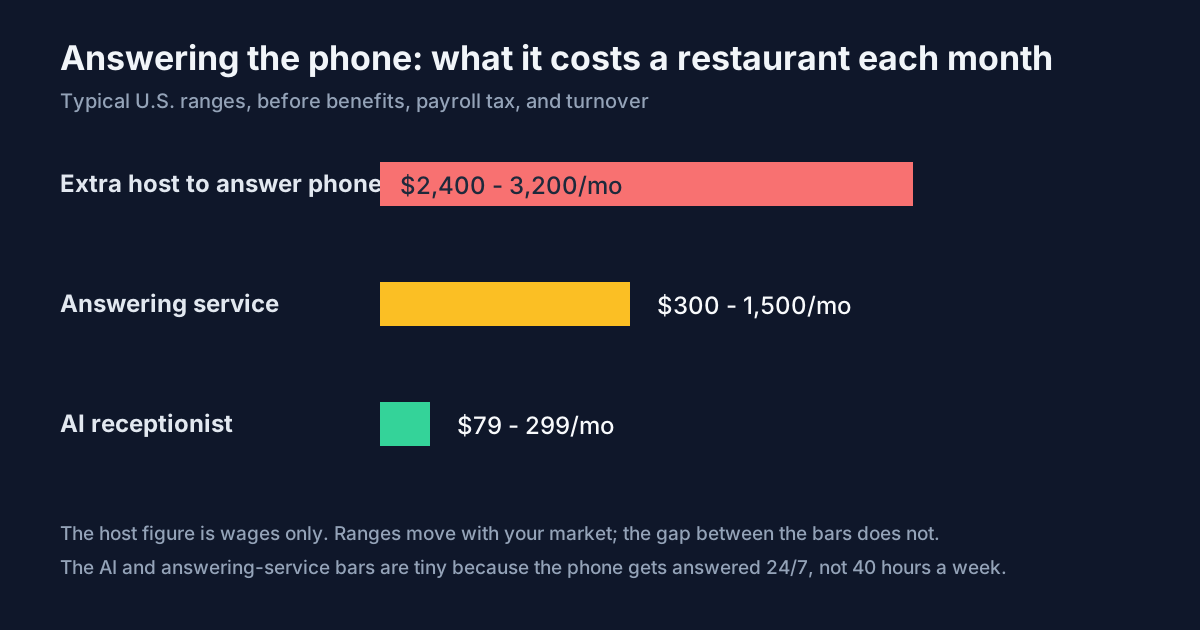
| Typical monthly cost | $79-299 | $300-1,500 | $2,400-3,200 in wages |
| Sounds like your restaurant | Yes, trained on your menu | Generic | Yes, eventually |
The row most restaurant owners underestimate is the second one. An answering service that takes a message at 7pm means your host spends the evening playing phone tag, and the customer who called has already ordered from the place that answered. Taking the order in the moment, at 7pm on a Friday, is the feature that pays for everything else.
Where it still falls short, honestly
I sell this stuff, so let me tell you where it does not work, because you will find out anyway.
It cannot taste the food or see the plate. Your best server can hear "the usual" from a regular and know exactly what that means. An AI only has the caller's words, and callers are terrible at describing what they want. "Something light" could be anything. The fix is to train the AI to ask good follow-up questions and to read the order back, but do not expect it to know your regulars the way your staff does.
Allergy and dietary questions need a hard rule. A caller with a severe nut allergy is not a casual FAQ. The AI's job here is to flag the allergy clearly on the order, repeat it back, and, if the question goes beyond the menu notes you gave it, escalate to a human rather than guess. Any vendor that claims their AI can "handle" allergy advice is selling you something dangerous. Ask how their escalation works and test it with a real allergy question.
Some customers will always want a human. Older customers especially, and anyone who is upset or celebrating something big. A good system does not fight this: it offers a callback from a real person without making the caller feel difficult. The goal is not to automate every call, it is to make sure no call goes unanswered. The 10% that need a human get one faster because the AI handled the other 90%.
Setup is real work, about an hour of yours. The AI needs your menu, prices, modifiers, pickup times, reservation rules, delivery radius, and FAQ answers. Nobody can skip this step, and any vendor that says "we handle everything, you do nothing" is selling you a generic bot wearing your restaurant's name. Budget an hour, do it once, and the thing actually works. You can read how the setup works if you want the step-by-step.
Questions restaurant owners always ask
The bottom line
A restaurant does not need AI phone answering because AI is exciting. It needs it because the phone rings hardest when your people are busiest, and it keeps ringing after your people go home. Every unanswered call is a takeout order that went to the place down the street, a reservation that became someone else's table, a catering inquiry that became someone else's event. Those are the three leaks, and they all come from the same place: a phone that only works when someone is free to answer it, in a business where nobody is ever free at the exact moment the phone rings.
What to look for comes down to a short list. A real takeout order, item by item, with your real menu and prices. Real reservations that respect your rules. After-hours coverage you have tested at 11pm on a Saturday. FAQ answers you can update yourself. A calm, fast escalation for the unhappy caller. The allergy and special-instruction details your kitchen needs, captured on every order. Missed-call text-back included, not upsold. And a menu you can update yourself in a minute when the special changes.
Get those eight right and the phone stops being the thing that costs you orders while your dining room is full. The takeout orders get taken, the reservations get booked, and the 11pm caller planning tomorrow's lunch becomes your customer instead of someone else's. If you want to run your own numbers first, you can see what the plans cost and do the math against one saved takeout order a night. It is a short calculation. And if the same problem sounds familiar in your other service work, the same setup fits HVAC just as well.
Ready to never miss another call?
24x7 AI answers every call on your business line, books appointments, and captures leads around the clock. Concierge setup, live in 48 hours, Plans from $79/month, including up to 250 call minutes.
See 24x7 AI in action