If your business misses calls, you have probably googled "answering service for small business" at some point. It is the obvious fix. A human answers, takes a message, you call back later. Problem solved, right?
Maybe. But you have also probably heard about AI receptionists by now, the software that answers your calls, books appointments, and answers questions around the clock. So which one should you actually get?
I am biased, obviously. I build an AI receptionist. But I will give you the straight version, because picking the wrong one costs real money either way, and I would rather you make an informed choice than a fast one.

What an answering service actually does
An answering service is a company that hires people to answer phones for lots of businesses. When someone calls your number, the call routes to one of their agents, who follows a script you provided. They take down the caller's name, number, and reason for calling, then text or email you the message.
That is basically it. Some fancier services can do a bit more: transfer urgent calls to you, check a shared calendar, handle simple orders. But the core product is a human message-taker with your business name at the top of a script.
Answering services have been around for decades, and they have real strengths. Callers talk to a person. No one feels weird about it. And for some businesses, especially ones where every call is a complex conversation with a worried person, that human touch matters.
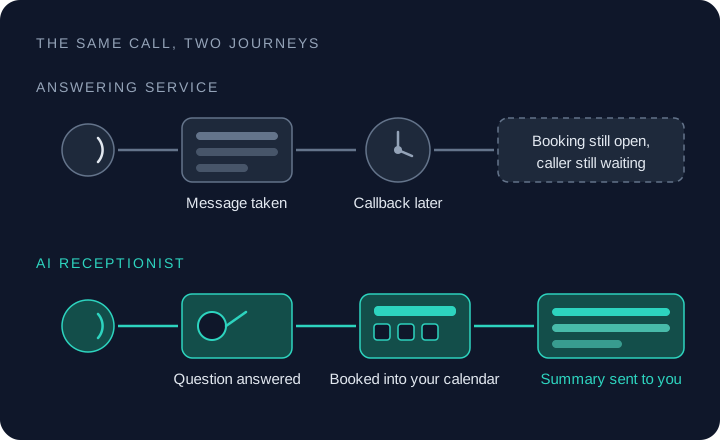
The weaknesses show up in the details. The agent answering your calls is also answering calls for forty other businesses. They do not know your prices by heart. They cannot describe your services. They cannot look at your actual schedule and book the caller into a real slot, because they do not have live access to your calendar, or if they do, it is a shared view they check manually. Most of the time, they take a message and promise you will call back.
And here is the part nobody mentions on the sales call: the per-call and per-minute fees. Answering services love to advertise a low base rate, like 59 dollars a month. Then you read the fine print and discover that covers 50 calls, and every call after that is a dollar or more, and a "call" can mean 90 seconds of hold time while the agent figures out which business this caller is trying to reach. I have seen small businesses end up paying 300 to 500 dollars a month for an answering service once real call volume hits. Always read the usage terms before you sign.
What an AI receptionist actually does
An AI receptionist is software that answers your phone line in seconds, greets the caller by your business name, and holds a real conversation. It is built on the same kind of voice technology as the assistants in your phone, but trained on your business: your services, your prices, your hours, your booking rules.
The practical difference from an answering service is that it does not just take a message. It handles the call. It answers "how much does a drain cleaning cost" with your actual price list. It books the caller into your real calendar. It takes a takeout order, logs a service request, or collects an intake form, depending on how you set it up. After the call, it texts you a summary so you know what happened without listening to anything.
The honest limitations: it is still software. If a caller is crying, angry, or dealing with something genuinely unusual, a well-built system should hand the call to you or your team, not fake its way through. And there is a segment of older customers who would rather talk to a person no matter what. That is a real thing, and you should factor it in.
The honest comparison
Here is how they stack up on the things that actually matter day to day.
| Answering service | AI receptionist | |
|---|---|---|
| Cost | 60 to 500+ dollars a month depending on call volume | 49 to 349 dollars a month, usually flat |
| Availability | 24/7, but quality varies by shift and staffing | 24/7, every call, no shifts or sick days |
| Answering questions | Follows a script, limited knowledge of your business | Answers from your actual service and pricing info |
| Booking appointments | Usually takes a message for you to call back | Books directly into your live calendar |
| After-hours emergencies | Takes a message or pages you per script | Qualifies urgency and routes or dispatches per your rules |
| Response time | Fast pickup, but agents juggle many businesses | Picks up in seconds, dedicated to your caller |
| Scalability | Costs rise with every call | Flat pricing regardless of volume |
| Caller experience | A human, but generic and sometimes rushed | A natural conversation, but still a machine |
A few of these deserve more explanation, because the table hides the nuance.
On cost. The answering service pricing model is the thing that burns people. Flat-rate AI receptionist plans usually include a generous number of minutes, and overage is straightforward. Answering services bill per call or per minute, and their definition of a "call" tends to be generous toward them. Run the numbers on your actual call volume, not the advertised base price.
On booking. This is the biggest functional gap. "We will have him call you back" is the answering service's default output. Every callback you have to make is time you are not doing billable work, and some percentage of those callers will have already booked with someone else. An AI receptionist that books into your calendar captures the job at the moment of interest, when the caller's intent is highest. For service businesses, that difference alone can pay for the whole system.
On knowledge. An answering service agent follows a script. An AI receptionist answers from information you provide, and you can update it anytime. Change your holiday hours? Update it once. Add a new service? Update it once. With an answering service, you are emailing your account manager and hoping the script gets updated before the next shift.
When an answering service is the better choice
I want to be fair, so let me name the cases where I would honestly recommend the answering service.
If most of your calls are complex, emotional, or high-stakes conversations where a human's judgment matters in the moment, keep a human in the loop. Think law firms handling sensitive intake, funeral homes, medical practices dealing with distressed patients. An AI can help with the routine parts, but the core call should be a person.
If your customer base is overwhelmingly older and deeply uncomfortable with anything automated, the friction may cost you more than the service saves. Know your customers.
If you get very few calls, like a handful a week, and each one genuinely needs a human decision on the spot, an answering service's low base tier can be cheaper than any software. Though at that volume, your own voicemail and a fast callback might honestly be enough.
When an AI receptionist is the better choice
For most small service businesses, this is where the AI receptionist wins, and it is not close.
If you miss calls during work hours because you are with customers, on a job site, or in the chair with a client, you need something that handles the call, not just logs it. A plumber under a sink cannot call back for two hours. An AI receptionist books the job while he keeps working.
If after-hours and weekend calls matter to you, and they almost always do, the AI receptionist is dramatically better. HVAC emergencies happen at 2 a.m. Restaurants get reservation calls on Sunday mornings. A dental office gets the "I chipped a tooth" call at 8 p.m. An answering service takes a message at those hours too, but the AI qualifies the urgency and books or dispatches according to your rules.
If your call volume spikes, say storm season for roofers, summer for AC companies, tax season for accountants, the AI does not care. Ten simultaneous calls cost the same as one. An answering service will bill you for every one of them.
The hybrid setup most businesses end up with
Here is a secret from the field: it does not have to be either or. The setup I see working best is an AI receptionist as the front line, with smart handoffs. The AI handles the routine calls, bookings, questions, and order taking, and anything complex or emotional routes to you or your team instantly. You get the coverage and the cost structure of automation with a human safety net for the calls that need one.
Some businesses keep a small answering service retainer as a backup for overflow during their busiest weeks. That is fine too. The point is to match the tool to the call type, not to pledge loyalty to one approach.
What to ask before you sign anything
Whether you go with an answering service or an AI receptionist, ask these questions before you commit.
For an answering service: what counts as a billable call? What is the per-call or per-minute rate after the included tier? Can agents book into my actual calendar, or do they only take messages? How quickly are script changes applied? What is the contract term, and is there a setup fee?
For an AI receptionist: what is included in the monthly plan, and what does overage cost? How does it handle calls it cannot resolve, and how fast does the handoff reach me? Can I update its knowledge myself, or do I need to file a ticket? How long does setup actually take? Is there a trial or pilot so I can hear it handle real calls before I commit?
The vendors who answer these clearly are the ones worth your money. The ones who dodge them are telling you something too.
The bottom line
An answering service is a better voicemail. An AI receptionist is a better front desk. If your problem is just "someone should pick up," the answering service does the job. If your problem is "calls should turn into bookings, orders, and answered questions without me stopping work," that is the AI receptionist's lane.
Most of the small business owners I talk to have the second problem. They do not need a message taken. They need the call handled.
Ready to never miss another call?
24x7 AI answers every call on your business line, books appointments, and captures leads around the clock. Concierge setup, live in 48 hours, Plans from $79/month, including up to 250 call minutes.
See 24x7 AI in action