Every week a small business owner asks me the same question, usually in the same words: should I hire someone to answer the phones, or should I let an AI do it? They are not asking about technology. They are asking about money, and about what happens to their customers when the phone rings and nobody picks up.
I build AI receptionists for a living, so you should read this post the way you would read any vendor writing about their own product. I have a reason to make the AI look good. That is exactly why I am going to start with the honest numbers for both sides, including the parts where a human employee wins, because the decision is only obvious once you see the full bill for each option. Spoiler: the AI wins on cost by a lot, and it still is not the right answer for every business.

What a front-desk employee actually costs
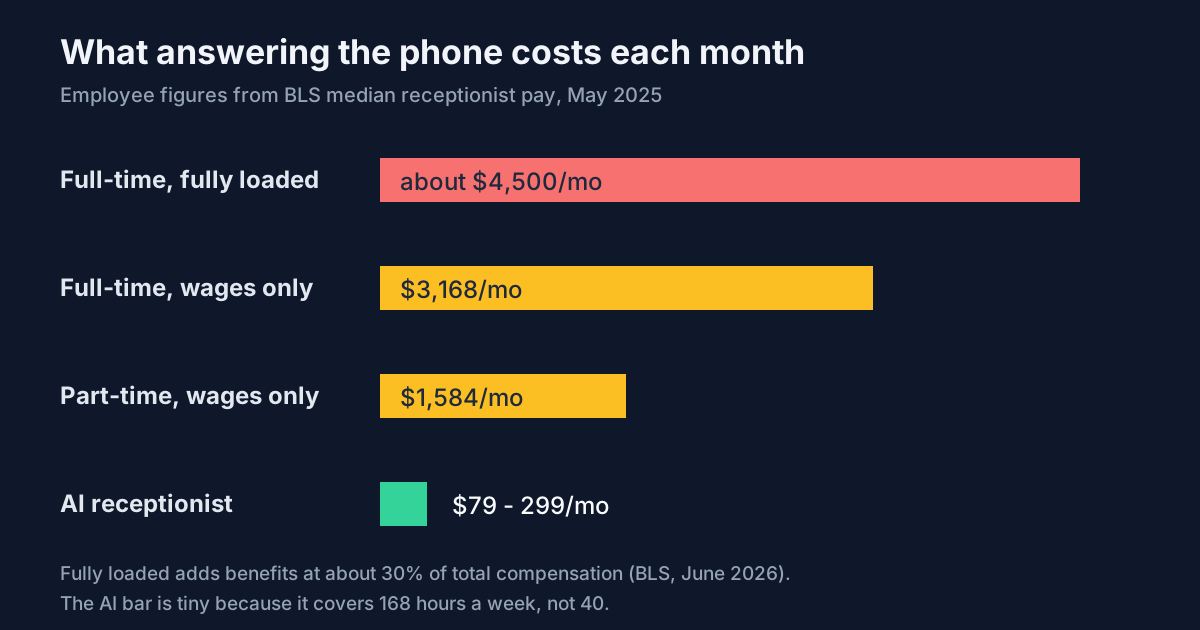
Let us start with the number most owners quote when they price a hire: the wage. The U.S. Bureau of Labor Statistics puts the median pay for receptionists at $18.27 an hour, or $38,010 a year, as of May 2025. That works out to about $3,168 a month in wages alone, for one full-time person working 40 hours a week.
But wages are not the bill. They are the first line of it. On top of the wage, an employer pays payroll taxes, and most employers pay for some combination of health insurance, paid time off, retirement contributions, and workers compensation. The Bureau of Labor Statistics tracks this too, in its Employer Costs for Employee Compensation data, and for private-industry workers benefits run to about 30 percent of total compensation. Run that math on the median receptionist wage and the picture changes: $38,010 in wages divided by 0.70 gives you roughly $54,300 a year fully loaded, or about $4,500 a month. That is the planning number, not the wage number, and it is the one your accountant will recognize.
And the fully loaded wage still is not the whole cost. Hiring one person costs money before they answer a single call. SHRM, the Society for Human Resource Management, puts the average cost of one hire at around $4,700, counting recruiting, interviewing, and onboarding. Then there is training: a new receptionist needs a few weeks before they know your services, your prices, your regulars, and your rules for what counts as urgent. During those weeks you are paying full salary for partial output, and someone on your team is spending their own hours teaching instead of doing their job.
Then there are the days the desk is empty. A full-time employee gets sick, takes vacation, and has emergencies of their own. Ten to fifteen days a year is normal, and on every one of those days the phone goes back to ringing out or hitting voicemail unless you have a backup plan. Turnover is the other hidden line. Receptionist roles turn over faster than most office jobs, and every time someone leaves you pay the hiring cost again and start the training clock over.
If full-time feels like too much, the part-time math is worth doing honestly too. Twenty hours a week at the median $18.27 an hour comes to about $1,584 a month in wages alone, before taxes and benefits. That covers half the working week. The other half, plus every evening and weekend, the phone is still on its own. Part-time saves money, but it buys you half a solution.
What an AI receptionist actually costs
Now the other side. Our AI receptionist plans run $79 a month for Starter, $149 for Pro, and $299 for Scale. That is the whole monthly bill: no payroll taxes, no benefits, no hiring cost, no training weeks, no sick days. Setup takes about an hour, because you are configuring it with your services, prices, hours, and rules, not teaching a new hire your business from scratch over a month.
For that money you get a system that answers every call on the first ring, books appointments, takes orders and messages, answers the questions you trained it on, and hands the caller to a person the moment they ask. It does this at 2pm on a Tuesday and at 9pm on a Saturday, and it does it for two callers at the same time without putting either on hold. You can see how the setup works before you decide anything.
The catch, and there is one, is that the AI only does the phone. It does not greet walk-in customers, it does not sort the mail, it does not restock the waiting room, and it does not do the dozen small jobs a good front-desk person absorbs without being asked. If you are hiring a receptionist because your office needs a person at the desk, the AI does not replace that person. It replaces the phone part of their job, which is a different thing, and it matters a lot which one you actually need.
The side-by-side numbers
Here is the comparison that actually decides it for most owners. The wages come from the Bureau of Labor Statistics, May 2025, and the AI prices are our published plans.
| AI receptionist | Full-time employee | Part-time employee | |
|---|---|---|---|
| Monthly cost | $79-299, all in | About $4,500 fully loaded | About $1,584 wages alone |
| Wages alone per month | No wages | $3,168 | $1,584 |
| Hours covered per week | 168, every hour | 40 | 20 |
| After hours and weekends | Yes, 24/7 | No | No |
| Sick days and vacation | Never | 10-15 days a year uncovered | Same, on their days |
| Hiring and training cost | $0, about an hour to set up | About $4,700 to hire, weeks to train | Same hiring cost, less training |
| Books appointments and takes orders | Yes | Yes | Yes |
| Greets walk-in customers | No | Yes | Yes |
| Handles two callers at once | Yes, unlimited | No | No |
| First-year total, roughly | $948-3,588 | About $59,000 with hiring | About $24,000 with hiring |
Read the hours row twice, because it is the row that changes the decision. A full-time employee covers 40 of the 168 hours in a week. That is 24 percent of the week. The other 128 hours, the phone is on its own, and those are exactly the hours when your competitors are closed too and a caller who reaches a helpful voice books with you instead of waiting until morning.
The hours problem nobody puts in the spreadsheet
Most owners compare the two options as if they cover the same hours, and they do not. A receptionist works your business hours, and your business hours are the hours you are already staffed for. The calls you miss are not mostly the 10am calls. They are the 7pm calls, the Saturday calls, the lunch-hour calls when your one front-desk person stepped away, and the second call that comes in while the first one is still on the line.
Think about what that means in your trade. A dental office gets calls from parents booking after work, when the office is closed. An HVAC company gets the no-heat call at 11pm in January, and that caller is not waiting until morning. A restaurant gets the takeout order at 6:30pm on a Friday, while the host stand is slammed. In all three cases the human receptionist is off the clock, and the AI is the only option that is actually there.
This is also why the per-call math favors the AI so heavily. Take a business getting 200 calls a month. On the Starter plan at $79, that is about 40 cents a call. A full-time employee at $4,500 a month handling the same 200 calls costs $22.50 a call, and that is before counting the calls that came in after hours and never reached them at all. The employee is not expensive because they are slow or bad at their job. They are expensive per call because a person can only be in one place, during limited hours, handling one call at a time.
Where a human still wins, honestly
None of this means you should fire your receptionist. There are real jobs where a human is not just nicer, but better, and any vendor who tells you otherwise is selling you something.
The first is walk-in customers. If people come through your door, someone warm and competent standing there is worth more than any phone system. The AI never sees them. The second is judgment. A longtime patient who sounds upset, a regular who always asks for the same technician, a caller describing a problem that does not fit any category in your booking form: a good human reads the situation and adapts in ways an AI cannot. The third is the office glue work. The receptionist who notices the schedule has a gap and fills it, who remembers that Mrs. Alvarez prefers mornings, who flags that a supplier invoice looks wrong: that is not phone answering, that is running the front of your business, and it has real value.
There is also a simple emotional truth. Some of your customers, especially older ones, want a person, and they will ask for one. An AI that hands them to a person in seconds keeps those customers happy. An AI that traps them in a menu loses them. If you buy an AI receptionist, the handoff to a human is the feature that matters most, more than the voice and more than the price.
So the honest framing is not AI versus human. It is: which parts of the front desk are phone work, and which parts are people work? The phone work is the part the AI does cheaper, faster, and around the clock. The people work is the part you keep a human for, and you should pay that person well, because they are doing the job that actually needs a person.
The setup most small businesses actually land on
In practice, most of our customers land in one of three places, and the right one depends on your call pattern, not on your feelings about AI.
AI first, hire later. This is the most common path for a young or growing business. The AI answers everything from day one, including after hours, for $79 to $299 a month. When call volume grows to the point where a human at the desk earns their keep on walk-ins and office work, you hire then, and the AI stays on as the after-hours and overflow cover. You never pay $4,500 a month for a phone that only rings during business hours.
Human by day, AI after hours. This fits businesses with real walk-in traffic, like a dental office or a salon. Your receptionist handles the desk from 9 to 5, greets patients, and does the office work. The AI takes over at 5pm, on weekends, at lunch, and whenever two calls come in at once. You keep the human where the human matters and stop losing the calls that come in when they are gone.
AI only, no front desk. This fits trades and mobile businesses where there is no office for customers to walk into: a plumbing company, an HVAC outfit, a solo practice. There is no desk to staff, so there is no reason to pay for one. The AI is the front desk, and the money you save goes into the work itself.
Here is a quick way to decide. If your phone rings fewer than 40 times a week and your budget is tight, start with the AI and see what it catches. If walk-ins are a big part of your day, hire the human for the desk and let the AI cover the phone when they are not there. If your calls are worth a lot each, like emergency repairs or high-value bookings, get the AI now, because one saved after-hours call can pay for a month of it. And if you already have a great receptionist, do not replace them. Give them the AI as backup, so their sick days and lunch breaks stop costing you customers. You can see what the plans cost and run your own numbers.
Questions owners always ask
The bottom line
A front-desk employee costs about $54,000 a year fully loaded, covers 40 hours a week, and does a job no AI can fully do: greeting people, reading a room, and holding the front of your business together. An AI receptionist costs $79 to $299 a month, covers all 168 hours of the week, and does one job better than any person can: answering every single call, instantly, no matter when it comes in.
The mistake is treating them as the same purchase. They are not. One buys you a person at your desk. The other buys you a phone that never misses. Most small businesses need the phone that never misses first, because the calls you miss are the customers you never meet, and no receptionist, however good, is sitting at that desk at 9pm on a Saturday.
Add up your own numbers. Take your monthly call volume, your after-hours missed calls, and the value of one saved customer, and compare that against $79 a month on one side and $4,500 a month on the other. For most of the owners I talk to, the math answers the question before I finish asking it. If you want to run the numbers for your own business, you can see what the plans cost. One saved customer a week covers it.
Ready to never miss another call?
24x7 AI answers every call on your business line, books appointments, and captures leads around the clock. Concierge setup, live in 48 hours, Plans from $79/month, including up to 250 call minutes.
See 24x7 AI in action