Picture the call every small business owner is afraid of. Your phone rings, the AI picks up, and the caller hears a voice that is not quite human. Two seconds of silence. Then a click, and dial tone. That customer is gone, probably to your competitor, and you are left wondering whether the AI just cost you a job.
It is a fair fear, and it is the first question almost every owner asks me before they buy. So let me answer it with the actual numbers, not the sales version and not the scare version. Some customers do hang up on AI receptionists. Far fewer than the headlines suggest. And almost all of the hang-ups that do happen are caused by fixable design mistakes, not by the fact that the voice is artificial.
I run a company that builds AI receptionists for small businesses, so read me the way you would read any vendor writing about their own product: I have an incentive to make this sound good. That is exactly why this post leads with the uncomfortable numbers first. If the data looked bad for AI, I would rather you hear it from me than discover it from your own call logs.

What people say they will do
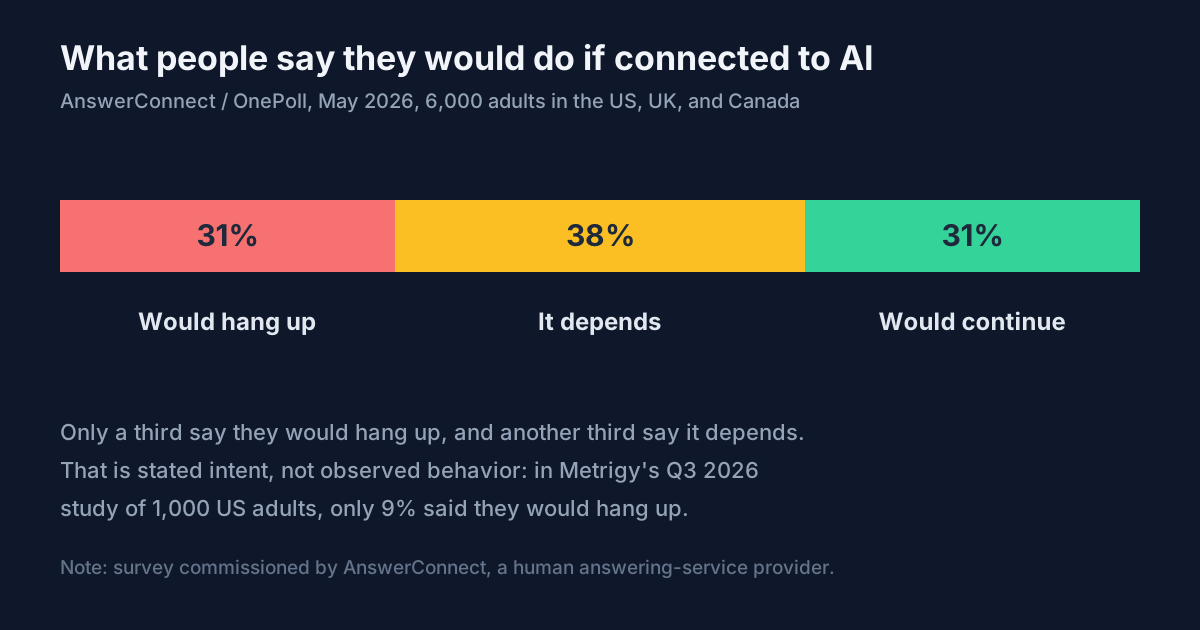
The scariest number in this whole debate comes from a survey AnswerConnect commissioned from OnePoll in May 2026. They asked 6,000 adults across the US, UK, and Canada what they would do if they were connected to an AI agent on the phone. 31% said they would hang up. Another 38% said it depends on the situation. Only 31% said they would stay on the line. In the same survey, 85% said they prefer a real person over AI, 87% said so for local services specifically, and 82% said they had asked to speak to a real person instead of AI at some point.
If you stop there, the case looks closed. A third of your callers hang up, and almost nobody prefers the AI. But stop and read the fine print before you act on that number, because it matters more than the number itself.
First, AnswerConnect sells human answering services. They commissioned the survey, and they have a commercial interest in a pro-human result. That does not make the numbers fake, but it makes them an upper bound on skepticism, not a neutral benchmark. A vendor survey that flatters the vendor's own product deserves a second source before you trust it.
Second, and more important, the survey measures what people say they would do, not what they actually do on a real call. Stated intent and real behavior are different things, and on phone calls they are very different things. People say they would hang up on AI. Then their dentist's office is closed, their pipe is leaking, and the AI is the only voice answering at 9pm. Most of them stay, because the alternative is waiting until morning with a flooded kitchen.
That gap between what people say and what people do is the whole story of this post. The surveys that measure real behavior tell a much calmer story than the surveys that measure opinions.
What people actually do
The best behavioral data I found comes from Metrigy's Q3 2026 AI Consumer Experience Index, which surveyed 1,000 demographically representative US adults in August 2026. In that study, only 9% said they would hang up on an AI voice agent. A third wanted the option of a human immediately, which is a different thing from hanging up, and most respondents were fine with a mix: 39% preferred AI and human agents switching automatically based on complexity, 37% preferred human-led service supported by AI, and 24% preferred AI-led service with people available when needed.
Read those two surveys side by side. One says 31% would hang up. The other says 9% would. The difference is not a rounding error, it is the difference between asking people to imagine a hypothetical robot and asking people who have actually used one. The first number is a fear. The second number is closer to a behavior.
The satisfaction data points the same way. COPC surveyed more than 1,000 recent users of AI customer service across six countries in January 2026, covering chat, voice, and messaging. 74% were satisfied with their most recent AI interaction, and satisfaction rose above 90% among interactions that were resolved without further steps. The lesson is not that AI is universally loved. It is that resolution is what people remember. A caller who gets their appointment booked does not go home angry about the voice that booked it.
And here is the number that matters most for a small business owner. A SurveyMonkey study of 2,017 US adults in December 2025 found that 79% prefer human customer service over AI, but 82% would rather talk to an AI than wait for a human agent. That is the trade your callers are actually making. They are not choosing between a perfect human and a robot. They are choosing between an AI now and a human later, or between an AI now and voicemail, or between an AI now and nobody at all. When the choice is framed that way, the AI wins, because waiting is the thing people hate most.
None of this means every caller is happy. A Metrigy study of 503 US and Canadian adults found 84.9% still prefer a human agent, and 80.1% still prefer a human even when told either option would resolve the issue. Deloitte's 2026 survey of 4,156 UK consumers found 61% would be less inclined to engage if they knew they were talking to a generative AI assistant. The preference for humans is real, it is large, and any vendor who tells you otherwise is lying to you. The honest claim is narrower, and it is the one that matters for your business: most callers will stay on the line and get helped if the AI is fast, honest about what it is, and able to hand them to a person the moment they ask.
Why callers actually hang up
When a caller does hang up, it is almost never because a robot answered. It is because the call went wrong in one of a handful of specific ways, and every one of them is a choice the business made during setup.
The AI pretends to be human. This is the biggest one. A caller who realizes they have been tricked feels conned, and conned people hang up. The fix is the opposite of what most vendors do: disclose it in the first sentence. "Hi, this is the AI assistant for Bright Smile Dental, I can book your appointment or take a message." Callers who know what they are talking to relax. Callers who figure it out mid-sentence do not. The AnswerConnect survey backs this up: 85% of respondents said it should be clearly indicated when they are interacting with AI. Give them what they asked for.
There is no way out. A caller asks for a person and the AI says "I can help you with that" and carries on. That is a trap, and people hang up on traps. A good system treats "let me speak to a person" as a command, not a suggestion, and hands the call off or takes a callback number within seconds. If your vendor cannot show you the exact words the AI uses when someone asks for a human, do not buy it.
The call goes in circles. "I understand you want to book an appointment. Can you tell me what day works for you?" "Tuesday." "I understand you want to book an appointment. Can you tell me what day works for you?" Two loops and the caller is gone. This is a configuration failure, not an AI failure: the system was not given a fallback for a misunderstood answer, so it repeats itself until the caller gives up. The test is simple. Call the demo line, give a confusing answer on purpose, and see what happens on the second try.
The AI is slow or silent. A five-second pause after every answer feels like a dead line, and people hang up on dead lines. A fast system answers in under a second and fills short pauses with a natural "got it" or "one moment." If the demo line feels laggy, your customers will feel it too, and the hang-up rate will show it.
The AI is doing the wrong job. Some calls should never be automated. A furious customer with a billing dispute, a caller reporting a gas leak, a parent trying to reach a pediatrician about a sick child: these are human calls, and routing them to an AI is how you lose a customer permanently. The system needs rules for which calls go to a person immediately, and those rules need to be set by someone who knows your business, not left at the vendor's defaults. The same applies across industries. A dental office needs a fast path to a human for a patient in pain, an HVAC company needs one for a caller with no heat in January, and a restaurant needs one for a caller whose order is wrong and who is already upset.
AI receptionist vs voicemail vs nobody: what the caller experiences
Hang-up rates only mean something against the alternative, and the alternative is not a cheerful human answering on the first ring. For most small businesses, the alternative is voicemail, a phone that rings out, or a harried employee who answers while doing three other things. Here is the comparison that actually matters.
| AI receptionist | Voicemail | Phone rings out | |
|---|---|---|---|
| Caller gets helped in the moment | Yes, most requests | No, leave a message | No |
| Caller can book or order now | Yes | No, wait for a callback | No |
| Caller can reach a human on request | Yes, if configured | No | No |
| Works after hours and weekends | Yes, 24/7 | Yes, but no help | No |
| Handles two callers at once | Yes, unlimited | Yes, one message each | No |
| Texts a confirmation or callback | Yes | Only if someone calls back | No |
| Typical caller outcome | Helped or handed off | Waits, often calls a competitor | Calls a competitor |
| Typical monthly cost | $79-299 | $0-30 | $0, plus lost jobs |
That last row is the one owners forget. Voicemail costs nothing per month and loses jobs every week, because most callers who hit voicemail do not leave a message. They call the next business on their list. A 9% hang-up rate on an AI sounds bad until you compare it with a 100% non-response rate on a phone nobody answers. The AI does not have to be perfect. It has to beat nothing, and nothing is a very low bar.
The five fixes that keep callers on the line
If you are shopping for an AI receptionist, or you already have one and your hang-up rate worries you, these are the five things that move the number. They are all setup choices, which means they are all things you can check before you sign anything.
1. Disclose it in the first sentence. "Hi, this is the AI assistant for [your business]." No fake name, no fake breathing, no pretending. Callers respect honesty and punish deception. This one change does more for your hang-up rate than any voice upgrade.
2. Put the human escape hatch front and center. The AI should offer it before the caller has to demand it: "I can book that for you, or I can connect you with the office if you prefer." And when a caller says "person" or "human" or "agent," the system hands off or takes a callback number immediately. A caller who knows they can reach a person any time stops looking for the exit.
3. Answer fast and keep the pace human. The AI should pick up on the first ring and respond in under a second. Short pauses need a "got it" or "let me check that" so the line never feels dead. If the demo line feels slow, it is slow, and your customers will notice before you do.
4. Resolve or hand off, never stall. Every question the AI cannot answer should have a defined next step: take a detailed message, text the owner, or transfer to a person. "I am not sure about that" followed by a useful action keeps a caller on the line. "I am not sure about that" followed by the same question again ends the call.
5. Train it on your real business, not a generic script. The AI needs your actual services, your real prices, your real hours, and your real rules for what counts as urgent. A caller who asks about a root canal and gets a generic "let me help you with that" is a caller about to hang up. A caller who hears the AI name the service and the next available slot stays. Budget about an hour for setup, and do it properly. You can see how the setup works before you decide.
How to test this before you buy
Do not trust any vendor's hang-up statistics, including mine. Test the system yourself, with your own worst-case calls, before you pay for it.
Call the demo line at 11pm on a Saturday and book something. Then call again and ask for a human in the first ten seconds, and time how long the handoff takes. Then call a third time and give a confusing, half-finished answer, and see whether the system recovers or loops. Then call a fourth time and pretend to be furious about a bill, and listen to what it says. If the vendor will only demo during business hours, or only with easy questions, that tells you everything about what your customers will experience at 9pm on a Tuesday.
Ask the vendor for their actual hang-up and completion numbers from live customers, not from a lab. Ask how they define a hang-up, because a caller who hangs up after booking is not a failure, and a caller who hangs up after thirty seconds of looping is. And ask what their completion rate looks like for your specific kind of business, because a dental appointment books very differently from a restaurant takeout order, and the vendor should be able to show you both.
Questions owners always ask
The bottom line
So, do customers hang up on AI receptionists? Yes, some of them do, and you should plan for it. But the number that matters is not the 31% from a vendor-commissioned survey. It is the 9% from a study of people who have actually used these systems, and the 82% who would rather talk to an AI than wait for a human, and the 90%-plus satisfaction rate among callers whose issue actually gets resolved.
The callers who hang up are mostly hanging up on a bad experience, not on a robot. A system that discloses itself honestly, offers a human in the first ten seconds, answers fast, and hands off cleanly when it is out of its depth keeps almost everyone on the line. A system that pretends to be human, traps callers in loops, and hides the exit loses them, and it would lose them no matter whose voice it used.
The choice is not between an AI and a perfect receptionist. It is between an AI and a phone that rings out, a voicemail nobody checks, and a front desk that is already doing three jobs. Against that comparison, the AI does not need to be loved. It needs to answer, help, and hand off when asked. Set it up that way, test it with your worst calls before you buy, and the hang-ups mostly take care of themselves. If you want to run the numbers for your own business, you can see what the plans cost. One saved customer a week covers it.
Ready to never miss another call?
24x7 AI answers every call on your business line, books appointments, and captures leads around the clock. Concierge setup, live in 48 hours, Plans from $79/month, including up to 250 call minutes.
See 24x7 AI in action